Migration & Modernization
Govern AI Adoption Before It Governs You
Why the modernization era’s biggest governance challenge is the one your security team cannot see, and how to solve it on AWS.
Your company is already running Shadow AI. Somewhere in your organization this week, an employee is pasting something they should not into an AI tool you have not approved. They are trying to do their job, not subvert it, and there is no process for telling them otherwise. By the time the prompt is submitted, the data has left the building.
This post explains why Shadow AI is the modernization era’s defining governance challenge and walks through a governance model (people, process, and technology on AWS) you can begin standing up this quarter.
Since early 2023, this has been the operating reality of every enterprise large enough to have a security team, and the problem compounds with every workload that moves to the cloud. Cloud migration programs deliver new capability faster than governance can keep pace. The gap between what employees can reach and what the organization has approved is the widest it has been in twenty years.
The Shadow IT Analogy Used Honestly
Shadow AI is Shadow IT with a wider scope and a faster pace of adoption. The remedy is the same: make the sanctioned path the easiest path. AWS codifies this approach in two frameworks. The prescriptive guidance for building an internal developer platform defines the sanctioned golden path: an approved route straightforward to use that deviating feels like extra work. The AWS Cloud Adoption Framework for AI, ML and Generative AI then maps the foundational capabilities every AI program needs before scaling.
What has changed is the speed and severity of the harm. Shadow IT required someone to install software; Shadow AI only requires a browser tab. Shadow IT exposed static files; Shadow AI exposes reasoning, the business logic behind decisions, not just the data. And unlike a leaked spreadsheet, an AI’s confident wrong answer doesn’t sit idle. It writes back into production systems and becomes the basis for real decisions before anyone thinks to verify it.
The Numbers Most Boards Haven’t Seen
- 55% → 71% in one year. Stanford HAI’s 2025 AI Index reports that organizational AI adoption jumped from 55% to 78% in a single year, the technology is entering the enterprise faster than most governance programs were built to handle.
- 90% vs. 4%. McKinsey’s State of AI finds that nine out of ten employees use generative AI at work, but the C-suite believes only 4% use it heavily. That perception gap is the blind spot.
- $670,000 per incident. IBM’s 2025 Cost of a Data Breach Report attributes that figure to each inadvertent AI access event, and 97% of organizations that experienced one lacked AI access controls entirely.
The consequences are no longer hypothetical. In 2023, a New York attorney submitted a legal brief to federal court citing six case precedents that did not exist, all generated by ChatGPT, complete with fabricated docket numbers and judicial opinions. The court sanctioned the firm publicly. The episode illustrates a broader truth: generative AI is evolving faster than any organization’s ability to fully model its risks. New model capabilities, new attack surfaces, and new regulatory interpretations arrive on overlapping timelines, and no framework written today will be complete tomorrow. The goal is not to eliminate uncertainty but to govern through it.
The Risk Surface Ranked
Two risks deserve immediate attention because most current programs miss them. The first is embedded AI inside sanctioned Software as a Service (SaaS). A meeting tool, messaging platform, or collaboration suite ships an AI feature in a routine update. Now the organization is running Shadow AI inside tools it formally approved. Procurement reviewed the vendor; it did not review a feature that did not exist when the contract was signed. The second is prompt injection, where a threat actor hides unintended instructions inside a document, email, or webpage that an AI tool reads and follows. It is ranked LLM-01 (the #1 vulnerability) in the OWASP Top 10 for Large Language Model Applications, a security industry standard that catalogs the ten most critical risks specific to LLM-powered systems.
The four remaining vectors are well-mapped. Inadvertent disclosure of sensitive data is addressed by existing data loss prevention controls, while organizations mitigate hallucinated decisions through grounding, Retrieval Augmented Generation (RAG), and human review thresholds. Supply-chain risk from unvetted models can be managed with curated catalogs and provenance checks, and regulatory exposure is mapped by frameworks already in wide use. On the regulatory side, two frameworks define the compliance floor. The EU AI Act already requires organizations to maintain an inventory of AI systems in use. The NIST AI Risk Management Framework and its Generative AI Profile provide the operational structure most mature programs are adopting to satisfy both European and U.S. expectations. If your governance program doesn’t start from these two baselines, it will have to retrofit them later.
The 30-day quick-start: You do not need to solve everything before you ship something. The recommended strategy is to run discovery and delivery in parallel:
- Week 1–2: Discovery. Audit the AI features silently embedded in SaaS tools you already approved (collaboration suites, CRMs, and code editors are the usual suspects). Run a prompt-injection test against your existing AI tools to confirm whether they follow unintended instructions hidden in documents or webpages.
- Week 2–3: Green-list one capability. Pick a single, low-risk generative AI use case (e.g., internal summarization with no customer data), wire it through your identity provider for SSO, and publish it as the first “green” option employees can use today.
- Week 3–4: Enforce the red line. Block or restrict the highest-risk shadow tools identified in discovery, but only after the approved alternative is live, so employees have somewhere legitimate to go.
The point is that employees get a sanctioned option inside 30 days while governance catches up, not 9 months later when the shadow tools are entrenched.
Why Your Best People Are the Worst Offenders
Shadow AI is a product-quality problem. Full stop. Nobody bypasses an internal tool because they enjoy risk. Instead, they go the unsanctioned path because approved tools offer a worse experience. For a new enterprise AI vendor, procurement, privacy, and security reviews can take a considerable amount of time end to end. In that same window, model providers ship a fresh wave of foundation models. Stanford HAI’s 2025 AI Index counted 149 released in 2023, more than double the year before. By the time an enterprise approves a model, the version a new hire is using on a personal device is already two generations ahead. The sanctioned path feels like a downgrade, so rational people route around it.
When the approved path is slower and less capable, rational employees route around it. Cisco’s 2024 Data Privacy Benchmark found that 48% of organizations reported employees entering non-public company information into GenAI tools, while the same employees largely believe their use is low-risk. Security leaders are not fighting defiance; they are fighting invisibility.
Tighten the ban and usage migrates to personal devices on home networks where telemetry is zero. Loosen it and exposure scales. Neither response works.
The Sanctioned Path in Practice
The organizations handling this well borrow from the platform-engineering discipline that underpins their cloud migration programs. They publish a paved road – an approved path capable enough that choosing anything else feels like work. A paved road needs two reinforcing layers. The people layer makes the judgment calls technology cannot, and the technology layer makes the approved path measurably better than the shadow one. Stand up the people layer first, or the technology layer becomes a procurement decision dressed up as a strategy.
The People Layer: The AI Governance Council
Every organization serious about Shadow AI eventually arrives at the same conclusion. Governance needs a named, cross-functional body of senior leadership that meets on a cadence, owns decisions, and is accountable for outcomes. The most common name for that body is the AI Governance Council.
The council decides the questions tooling cannot. It owns which AI tools move to the allowlist, and what data is allowed into which models. It also sets how far an autonomous agent can act before a human approves, and whether a use case should be paused, expanded, or redesigned. These are judgment calls about risk appetite, brand, and ethics, and they belong to people, not to a procurement form. Deloitte’s 2025 State of Generative AI in the Enterprise is explicit that senior-leadership-led AI governance produces more business value than governance delegated to technical teams.
The Technology Layer
For organizations already running modernization on AWS, the sanctioned AI capability is a natural extension of the same architecture. We recommend a stack with three layers.
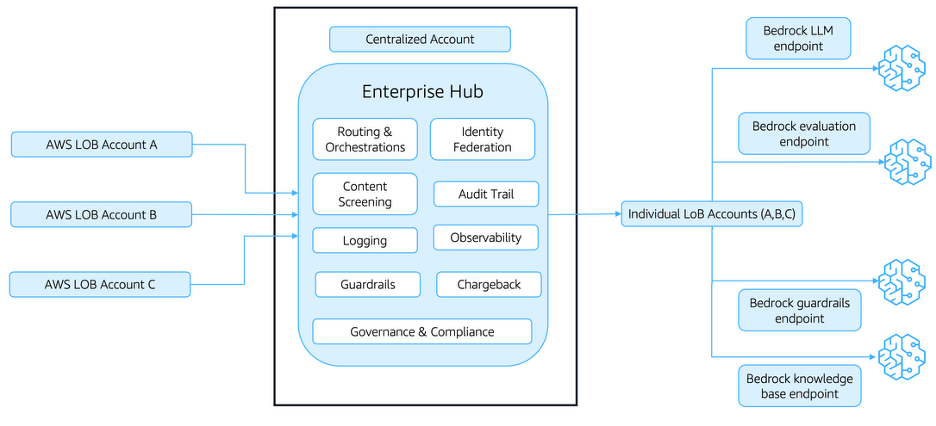
Figure 1. Enterprise Hub architecture – routing, identity, content screening, logging, guardrails, and governance in a centralized account.
Layer 1: Sanctioned access
Start with three front-door experiences that replace the most common shadow tools overnight:
- Amazon Quick (and the Amazon Quick desktop app) gives every knowledge worker a sanctioned AI teammate for email, documents, data analysis, and meeting prep, all running inside your identity perimeter.
- Kiro gives engineers a sanctioned coding agent that keeps code generation, reasoning, and context inside the organization’s trust boundary instead of leaking to third-party endpoints.
- Amazon Bedrock provides the foundation underneath both. It is a single enterprise contract over a curated model catalog (Anthropic Claude, Meta Llama, Mistral, Amazon Nova, and Cohere). Your company data stays isolated to your AWS account and is excluded from model training.
Layer 2: Policy and grounding
Amazon Bedrock Guardrails applies content and data policies at inference time. Automated Reasoning checks in Amazon Bedrock Guardrails use mathematical logic to validate model output against policies you encode from your own documents. In policy-bound domains, this is the most direct way to reduce hallucinated answers. Amazon Bedrock Knowledge Bases connect sanctioned models to your company’s own documents, the single feature most likely to convert a skeptical employee. Amazon Macie classifies sensitive data before any AI workload can see it.
Layer 3: Observability and evidence
AWS CloudTrail and Amazon Security Lake baseline usage. Amazon GuardDuty surfaces anomalies. AWS Audit Manager helps you collect evidence mapped to frameworks such as the NIST AI RMF and ISO/IEC 42001. When a regulator or board member asks what AI is in use, you have a documented place to start.
For deeper guidance, see the Generative AI Security Scoping Matrix , the Generative AI Lens for the AWS Well-Architected Framework , and AWS Prescriptive Guidance .
The principle that keeps the stack from becoming a restriction engine is simple: every preventive control must ship alongside a faster sanctioned alternative.
Shadow Agents Are the Next Chapter
Shadow AI today is mostly about prompts. The next wave is agentic. Agentic AI systems introduce autonomous capabilities, persistent memory, tool orchestration, and external system integration. When an employee connects an unvetted agent to a corporate mailbox or grants access to internal systems, the organization is dealing with an autonomous process that acts on its behalf without oversight. The Agentic AI Security Scoping Matrix provides the framework for classifying these risks.
The governance response is twofold. Scope the autonomy by defining which agents can act on behalf of your organization and what approval thresholds apply before irreversible actions run, per AWS Prescriptive Guidance for governing agentic AI. Secure the integrations by treating every agent-to-tool and agent-to-agent connection as an identity boundary (AgentCore Gateway with Policy and Lambda interceptors is one production pattern) while extending the council’s charter to cover agent registries, human-in-the-loop thresholds, and audit trails. Organizations that solve Shadow AI this year will govern Shadow Agents next year. Those that do not will face a compounding problem.
Where to Start This Quarter
Start with the people layer. Convene the AI Governance Council for its first working session within ninety days, with a named chair, a real charter, and a decision it must make at the next meeting. Stand up the two or three working groups under it on the same day, so the council does not become the bottleneck it was meant to remove. Then run the discovery work in parallel. Turn on AI telemetry in your network security stack, run the amnesty survey, and cross-reference expense reports against identity logs to find personal AI subscriptions charged as productivity software. Audit AI features embedded in sanctioned SaaS, publish a one-page approved, conditional, restricted list, and stand up one approved-tier capability with single sign-on before the restricted list is enforced, not after.
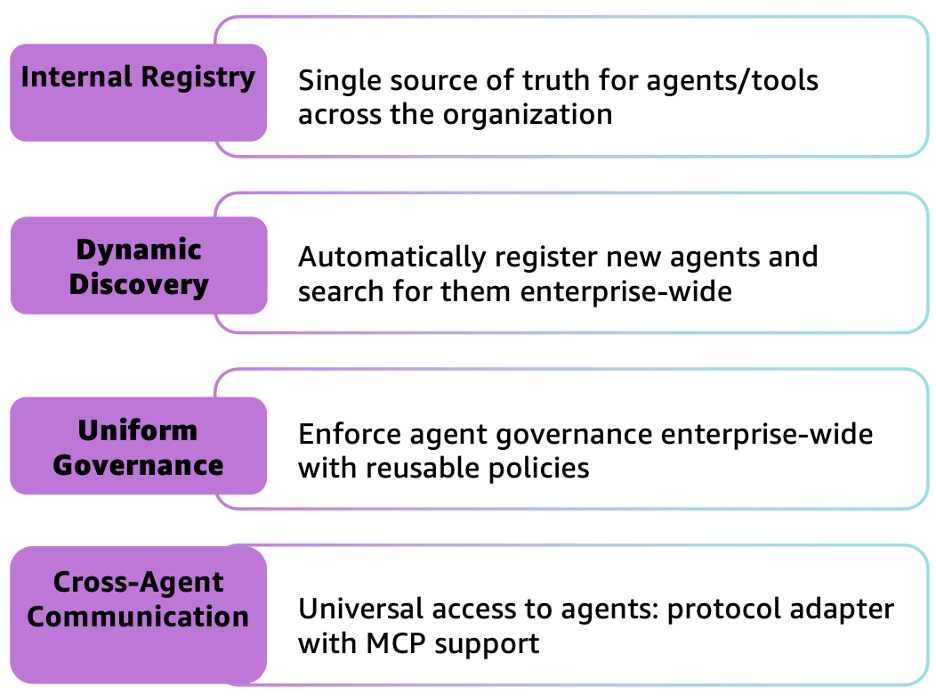
Figure 2. Enterprise AI Principles — Core Tenets for Scalable Agent Management
Organizations that built modernization muscle are best positioned to handle Shadow AI well. Route it, govern it, and put the decision in the hands of the people who carry the risk.
Conclusion
Start with the council, pave one approved-tier road employees actually want to use, and measure how much traffic follows it. Six months from now, the companies that moved first won’t be the ones with the tightest policies. They’ll be the ones whose employees stopped needing to go around them. That’s the only metric that matters.