Migration & Modernization
Everyone Adopted AI. Why Is Tech Debt Still Growing? And Two Moves To Close The Gap.
Most enterprise engineering organizations have deployed AI tooling broadly across teams. The per-team productivity gains are real. But end-to-end improvement hasn’t followed. Backlogs aren’t shrinking. Cycle times haven’t compressed. Tech debt is still growing.
The tools aren’t broken. The problem is structural: each team accelerated independently, and the spaces between them are now the entire bottleneck. This fragmentation blocks what comes next: autonomous agents that operate across the full lifecycle, not inside one silo. This post shows where fragmentation hides, how to close it in two moves, and how to measure it against your last refactoring efforts.
The fragmentation pattern
Consider the typical flow of a modernization effort across an organization where each team has adopted AI tooling independently.
Product management generates AI-refined requirements in their tools. Development writes code against an interpretation of those requirements, not a synchronized source of truth that updates as product thinking evolves. QA generates tests against whichever version of intent they last received, which may reflect the current spec or a version from three sprints ago. Security scans code that may have drifted from the latest requirements. DevOps deploys software that may not reflect what product management envisioned at the start of the sprint.
Each persona accelerated independently. The integration points between them did not.
The handoff points between groups, where one team’s output becomes the next team’s input, are where momentum stalls. Those handoffs remain manual and disconnected from shared context. Faster individual output without shared artifacts creates more rework at each boundary: more retesting after requirements shift, more re-alignment meetings, more late-discovered drift between intent and implementation. The net effect is that per-persona AI adoption makes coordination worse, not better. The faster each team moves independently, the faster they drift apart.
Google’s DORA 2024 research found that a 25% increase in AI adoption correlated with a 1.5% decrease in delivery throughput and a 7.2% decrease in delivery stability, even as individual productivity rose. The 2025 follow-up showed throughput turning positive, but stability (i.e., the rate and recovery cost of failures) remained negatively correlated with AI adoption. The tools made individuals faster. The system did not get more reliable.
Where the cycle time lives
The following table breaks a refactoring effort into development work (what AI accelerates) and integration overhead (what it does not).
| Lifecycle stage | Development work (shrinks with AI) | Integration overhead (doesn’t shrink) |
| Requirements → code | Writing refactored code | Waiting for review from context-switching reviewers |
| Code → tests | Creating tests | Re-creating tests after intent drift surfaces |
| Tests → deploy | Deploying to staging | Re-deploying after security finds spec-level ambiguity |
| Deploy → production | Validating in production | Reworking when behavior matches code but not current intent |
In organizations where each persona has AI tools, the left column shrinks. The right column does not. Development time shrinks while calendar time does not. AI-accelerated teams produce more artifacts faster, creating more handoff friction at each stage. LinearB’s analysis of 8 million pull requests across 4,800 engineering teams quantifies both sides of this problem. AI-assisted pull requests (PRs) are 2.6× larger than unassisted ones, but half of all PRs sit idle for over 50% of their lifespan, waiting for review, context, and alignment. The parts accelerated. The whole did not.
How a connected lifecycle closes the gap
The fix is connecting what happens between teams, not further accelerating what happens inside them. In an AI-native lifecycle, a set of mutual artifacts carry context from one phase to the next.
When product management updates a requirement, the spec that development works from updates with it. When development generates code, QA’s test suite regenerates from the same spec. When security examines the code, it validates against the same intent product management defined, not a stale interpretation. When the team ships, the deployment validates against the original requirement, so drift surfaces immediately instead of three sprints later.
The contrast between per-persona AI and a connected lifecycle is easiest to see side by side (Figure 1):
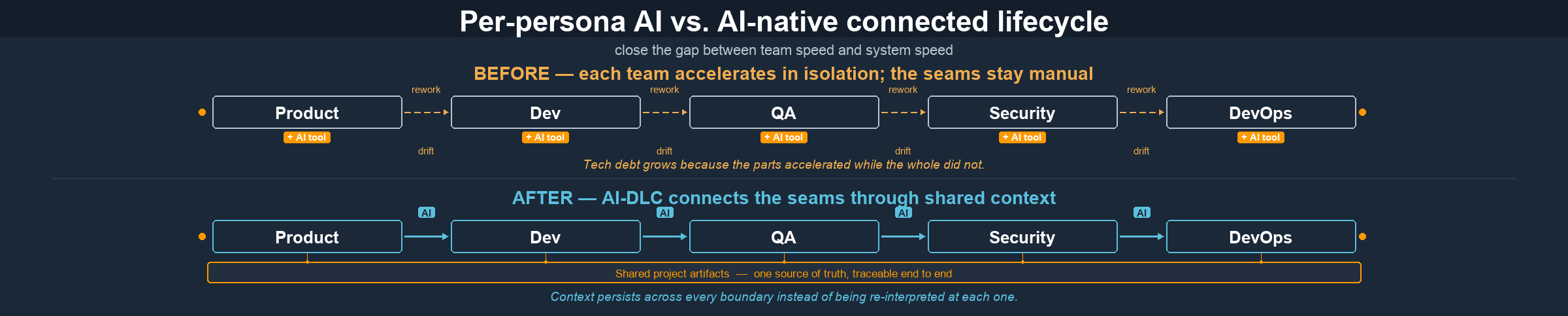
Figure 1. Per-persona AI tools leave the handoffs manual (top).
DriveWealth’s CTO described this shift in Forbes: “time saved at the keyboard is often lost elsewhere in manual security reviews, cross-team handoffs and QA testing. The broader inefficiencies of software development are left entirely untouched.” Their team adopted an AI-native lifecycle approach to address this fragmentation. They now take real production projects from business intent to deployed software, with AI orchestrating across the full lifecycle.
Two AWS programs formalize this approach, designed to work in sequence: one that establishes lifecycle connectivity (AI-DLC), and one that scales it (EBA).
AI-Driven Development Life Cycle (AI-DLC)
Traditional development relied on sprint ceremonies and shared reviews to keep teams aligned. In this methodology, AI orchestrates the lifecycle end-to-end while humans retain oversight and final approval at every checkpoint, validating proposals and approving before execution proceeds.
The methodology operates in three phases:
| Phase | What AI does | What the team does | Shared artifact produced | Why it matters |
| Inception | Generates requirements, stories, and work breakdown from business intent | Validates proposals and answers clarifying questions collaboratively | Living requirements document tied to project context | Intent is captured once, so downstream work never drifts from a stale spec |
| Construction | Proposes architecture, domain models, code, and tests | Clarifies technical decisions and approves before AI proceeds | Validated codebase and test suite with traceability to requirements | Tests and code stay tied to the same intent, so drift surfaces immediately, not three sprints later |
| Operations | Generates infrastructure as code, deployment configs, and monitoring | Oversight, approval, and exception handling | Deployment artifacts with full audit trail | Deployment reflects current intent, which removes the late rework that fills the integration column above |
With this methodology, project context accumulates across phases. The developer working in Construction doesn’t have to guess whether requirements changed last week. They work from the same living spec the Inception phase produced, with AI already aware of every decision made before them. When the team finishes Construction, Operations inherits the full chain. Requirements, architecture decisions, validated code, and test coverage all carry forward. No phase starts without the output of the one before it. That eliminates the re-interpretation problem described in the fragmentation section above.
AI-DLC is methodology-agnostic and works with any AI-capable development environment. Teams commonly adopt it through Kiro, AWS’s AI-native development tool, using the open-source adaptive workflows. The workflow adjusts which stages to include and how rigorous each one is based on the complexity of the work, so a simple defect fix runs through fewer stages than a net-new service.
For teams that want to accelerate AI-native adoption, AWS offers a structured 2-3 day engagement on your actual codebase, applying AI-DLC practices across the development lifecycle. The output is a cycle-time measurement against your pre-engagement baseline and a repeatable playbook your organization owns.
Experience-Based Acceleration (EBA)
EBA is a hands-on, agile, outcome-focused engagement where AWS technical experts work alongside your engineering team for a sustained sprint, typically 2-4 weeks, to accelerate execution and improve delivery outcomes. They pair on architecture decisions and coach your team through execution on real production workloads. The engagement changes how the team operates: siloed handoffs become cross-functional collaboration, and analysis-paralysis gives way to reversible, two-way-door decisions. Your engineers write and ship the code. AWS shortens the path to production.
EBA takes the AI-DLC practices proven on one workload and helps your team apply them at scale across your highest-priority modernization targets. The team that completed the AI-DLC engagement leads the work, pairing with teams on new workloads and transferring the practice as they go. AWS experts accelerate execution and help establish repeatable patterns.
The output is a repeatable pattern, a scaling playbook, and a team that now applies the connected practice to every subsequent workload independently.
Two moves to close the gap
Move 1: Establish the connected practice
Apply AI-DLC to one high-debt workload. The goal is to prove that end-to-end cycle time compresses when the lifecycle operates as a connected system rather than a set of independent silos. In practice, this typically begins with a 2-3 day engagement on a real workload from your backlog, not a proof of concept. The output is a cycle-time measurement against your pre-engagement baseline and a repeatable playbook your team owns.
In one early engagement with a European financial services team building new API features on a brownfield codebase, the team shifted from 12 developers delivering 15 features per sprint to 3 developers delivering 35. The team attributed the gain to eliminating re-interpretation and re-alignment at every handoff between planning, development, and deployment. Results reflect a single engagement and will vary by context.
Move 2: Scale across the portfolio
Once the practice is proven, run an EBA engagement to carry it across adjacent workloads. The first team leads; AWS experts accelerate. In practice, this is a sustained 2-4 week sprint where AWS experts pair with your teams on real workloads, transferring the connected practice as they go. Each workload the team completes builds the repeatable pattern for the next one.
For organizations that need to identify which workloads to target first, reach out to your AWS account team to scope a prioritization conversation before scheduling the EBA sprint.
How to identify this pattern in your organization
Pull two numbers from each of your last few refactoring efforts: total cycle time (first commit to production deploy) and coding time (first commit to first PR opened). Everything after that PR opens is integration time: review, rework, staging, security, deployment.
In most organizations, integration time exceeds coding time on every effort. Engineers actively build for days. The work takes weeks to reach production. The gap between those two numbers is the coordination bottleneck this post describes. It is not a capacity problem, and adding engineers or AI tools to the coding phase will not compress it.
That ratio gives you a conversation your architecture review or modernization standup hasn’t had yet: “Our engineers actively built this for X days. It took several times that to reach production. The gap is where we’re losing the cycle-time gains from AI.” Once you name the gap, the conversation shifts from “why is this slow” to “what do we do about the handoffs.
Assess your starting point
Work through these in order:
- Has AI connected all four stages (planning, build, test, deploy) on at least one real workload? If not, start with Move one.
- Is it changing business outcomes? Name one delivery that moved faster end-to-end, not a task that got quicker. If you cannot, the gains are still inside silos. Stay with Move 1 until this changes.
- Can you name the next workload to scale to and the person who sponsors that decision? If you have the workload but not the sponsor, build the business case using the diagnostic ratio above. If you have neither, reach out to your AWS account team to identify the right starting workload before scheduling an EBA sprint. If you have both, you’re ready to scope the EBA sprint.
What to do next
Closing the fragmentation gap starts with one workload and scales from there.
- Pick one high-debt workload and run a first AI-DLC engagement on it. Your integration overhead ratio is the business case.
- Measure the end-to-end cycle time result against your pre-engagement baseline. That number is what you bring to the next conversation about scale.
- Scope an EBA sprint to carry the practice across adjacent workloads.
To adopt AI-DLC independently, begin with the open-source workflows on GitHub and install Kiro. To scope an accelerated engagement, reach out to your Customer Solutions Manager or Solutions Architect.
The fragmentation wall your teams hit today is the one agents will hit tomorrow. Building the connected foundation now positions you ahead of both. AI-DLC establishes lifecycle connectivity; EBA scales it.
References:
- AI-Driven Development Life Cycle: Reimagining Software Engineering
- AI-DLC Open-Source Adaptive Workflows (GitHub)
- Sokasian, A. “Rebuilding Software Development From The Ground Up,” Forbes Technology Council, July 2026.
- AI-Driven Development Lifecycle for Financial Services
- Experience-Based Acceleration
- DORA Accelerate State of DevOps Report 2024
- LinearB: Engineering Benchmarks (8M+ pull requests)