AWS Open Source Blog
Category: Programing Language

Simplifying serverless best practices with Lambda Powertools
Modern applications are increasingly relying on compute platforms based on containers and serverless technologies to provide scalability, cost efficiency, and agility. Although this shift toward more distributed architectures has unlocked many benefits, it has also introduced new complexity in how the applications are operated. In times past, debugging was as straightforward as logging into the […]
Deploy machine learning models to Amazon SageMaker using the ezsmdeploy Python package and a few lines of code
Customers on AWS deploy trained machine learning (ML) and deep learning (DL) models in production using Amazon SageMaker, and using other services such as AWS Lambda, AWS Fargate, AWS Elastic Beanstalk, and Amazon Elastic Compute Cloud (Amazon EC2) to name a few. Amazon SageMaker provides SDKs and a console-only workflow to deploy trained models, and […]

What is Deno?
Deno 1.0, a runtime for JavaScript and TypeScript, rolled out in May with appealing features for JavaScript developers, including: Secure defaults: Explicit permission must be granted for your Deno applications in order to access disk, network, and runtime environments. Native TypeScript support: No tsconfig needed—Deno acts like a native TypeScript runtime. Under the hood Deno […]

Generate Python, Java, and .NET software libraries from a TypeScript source
As builders and developers, many of us are aware of the principle of Don’t Repeat Yourself (or DRY) and practice it every day. Entire runtimes and programming languages have been developed by taking that principle to an even higher level, with the core idea of writing software once and having it run on many different […]

Introducing Heapothesys, an open source Java GC latency benchmark with predictable allocation rates
The Amazon Corretto team introduces the open source Heapothesys benchmark, a synthetic workload that simulates fundamental application characteristics that affect garbage collector (GC) latency. The benchmark creates and tests GC load scenarios defined by object allocation rates, heap occupancy, and JVM flags, then reports the resulting JVM pauses. OpenJDK developers can thus produce reference points […]
Adopting machine learning in your microservices with DJL (Deep Java Library) and Spring Boot
Many AWS customers—startups and large enterprises—are on a path to adopt machine learning and deep learning in their existing applications. The reasons for machine learning adoption are dictated by the pace of innovation in the industry, with business use cases ranging from customer service (including object detection from images and video streams, sentiment analysis) to […]
Getting started with R on Amazon Web Services
This article is a guest post from David Kretch, Lead Data Scientist at Summit Consulting. As R workloads grow and become increasingly resource intensive, the ability to move from a local compute environment to scaleable, fully managed cloud services on Amazon Web Services (AWS) becomes extremely valuable for cost, speed, and resiliency reasons. In this two-part […]
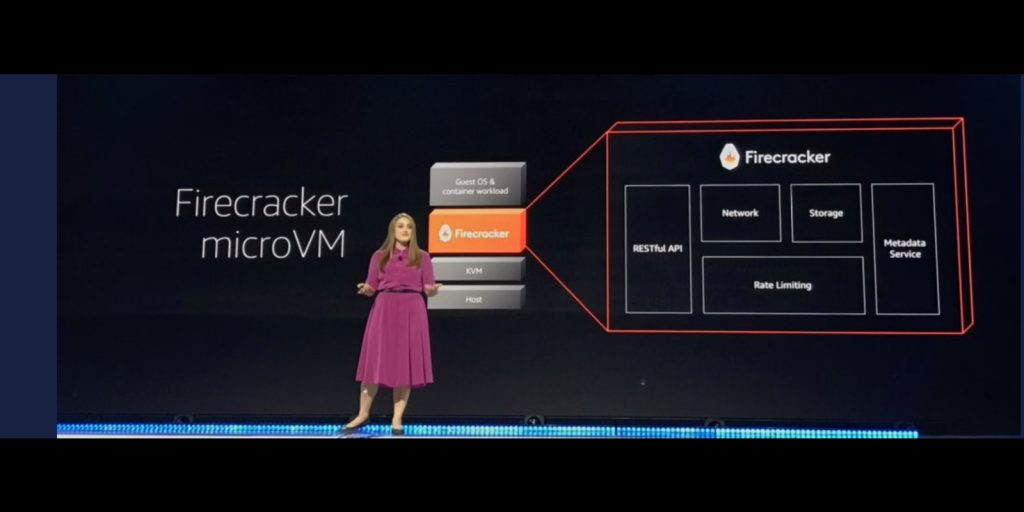
re:Cap part three – open source at re:Invent 2019
Wrapping up our final summary, we kick off with a roundup of the open source updates in the area of compute and emerging technologies. We start with a great explanation of Fargate on Firecracker from Clare Ligouri during Werner Vogel’s keynote, and proceed to a broad selection of the container sessions and workshops that ran […]
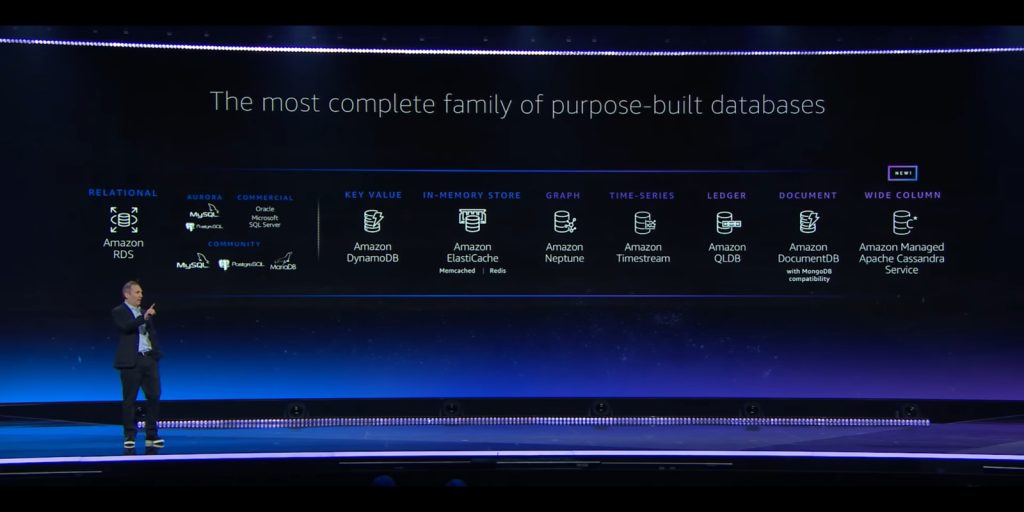
re:Cap part one – open source at re:Invent 2019
As the dust settles after another re:Invent closes, I wanted to put together a quick summary of all the open source-related announcements that happened in the run up to this year’s re:Invent and the week itself. If you are interested in open source in mobile web development, devops, containers, security, big data and data analytics, […]

Splitting an application’s logs into multiple streams: a Fluent tutorial
Not all logs are of equal importance. Some require real-time analytics, others simply need to be stored long term so that they can be analyzed if needed. In this tutorial, I will show three different methods by which you can “fork” a single application’s stream of logs into multiple streams which can be parsed, filtered, […]